WordPress vs Custom Code: Which Is Right for Your Business?
WordPress vs custom website: which should you choose? An honest comparison of WordPress and custom code for UK small businesses in 2026.
WordPress powers 43% of the web. That's not a typo. Nearly half of all websites on the internet run on WordPress. It's the default choice, and for many businesses, it's the right one.
But not for all of them. And the difference matters more than most people realise.
I build custom-coded websites for a living. So you'd expect me to trash WordPress. I won't. Instead, I'll tell you honestly when WordPress wins, when custom wins, and how to make the right call for your business.
Where WordPress Wins
Content-heavy sites. If you're publishing blog posts, articles, or resources regularly — multiple times per week — WordPress is hard to beat. Its content management system is mature, well-understood, and your team can use it without technical training.
E-commerce at scale. WooCommerce handles thousands of products, complex inventory management, and multi-currency payments. Building equivalent functionality from scratch would cost tens of thousands of pounds.
Tight budgets with ongoing updates. If you need a site fast, you'll update it frequently yourself, and budget is the primary constraint — a good WordPress theme with professional setup is a sensible choice.
Plugin ecosystems. Need a membership area? There's a plugin. Need multi-language support? Plugin. Need an event calendar with ticket sales? Plugin. WordPress has a solution for nearly everything.
Where WordPress Loses
Performance. A typical WordPress site loads 15-25 HTTP requests and 1-3MB of data on the homepage. A custom site doing the same job loads 3-5 requests and 100-300KB. Google's own web.dev guidelines are clear: performance is a ranking factor. Slower sites rank lower.
This isn't theoretical. I've rebuilt WordPress sites as custom code and watched the Lighthouse score jump from 40 to 95+. Same content, same design — just without the overhead.
Security. WordPress is the most attacked CMS on the internet — because it's the most popular. Outdated plugins, weak admin passwords, and unpatched cores account for thousands of hacked sites every month. A custom static site has no database to inject, no admin panel to breach, no plugins to exploit. The attack surface is essentially zero.
Maintenance. WordPress requires updates. Core updates, theme updates, plugin updates, PHP updates. Skip them and you're vulnerable. Apply them without testing and things break. Someone needs to manage this — either you or someone you're paying.
Custom sites built with modern frameworks like Astro or Next.js deploy once and run. There's no admin panel to maintain, no database to back up, no plugins to keep current.
Design freedom. WordPress themes impose structure. You can customise within the theme's boundaries, but pushing beyond them means hacking PHP templates and wrestling with CSS overrides. I've inherited WordPress sites where the customisation code was longer than a from-scratch build would have been.
The Honest Comparison
| Factor | WordPress | Custom Code |
|---|---|---|
| Speed to launch | Days-weeks | Weeks |
| Upfront cost | £500-£3,000 | £2,000-£10,000 |
| Monthly cost | £20-£100 (hosting + plugins) | £5-£20 (hosting only) |
| Page speed | Moderate-poor | Excellent |
| Security | Needs active management | Minimal surface |
| SEO ceiling | Good with effort | Excellent by default |
| Customisation | Within theme limits | Unlimited |
| Self-editing | Easy (CMS built in) | Needs headless CMS or dev |
| 3-year total cost | £1,200-£6,600 | £2,060-£10,720 |
The three-year total cost is closer than most people expect. WordPress's ongoing costs add up — hosting, premium themes, plugin licenses, security monitoring, backups, and maintenance time.
The Real Question
The deciding factor isn't technical. It's operational.
How often do you need to edit the site yourself?
If the answer is "weekly or more," WordPress (or a headless CMS connected to a custom frontend) makes sense. You need a dashboard. You need to publish without calling a developer.
If the answer is "rarely — maybe quarterly," custom code wins every time. You get better performance, better security, better SEO, and lower ongoing costs. When you do need a change, your developer makes it.
Most small businesses in Brighton fall into the second category. A restaurant changes their menu seasonally. A builder adds portfolio projects monthly. A salon updates prices once or twice a year. These don't require a CMS — they require a developer who responds quickly.
The Middle Ground
There's a third option that most people don't know about: a custom frontend with a headless CMS.
The website itself is hand-coded — fast, custom-designed, fully optimised. But content is managed through a separate CMS (Sanity, Contentful, or even WordPress as a backend). You get the editing experience of WordPress with the performance and design freedom of custom code.
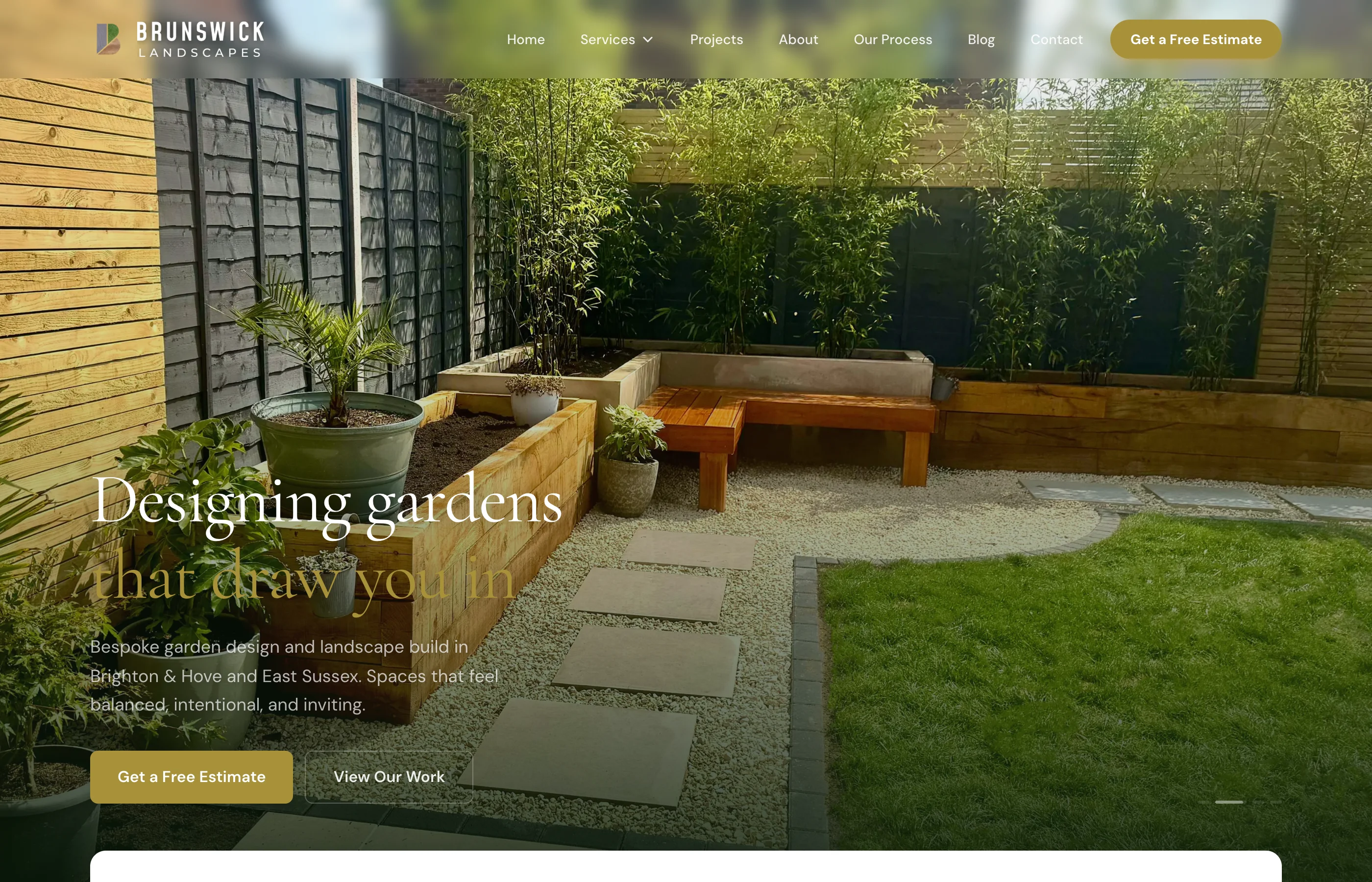
This is what I built for Brunswick Landscapes. Ed needed to manage his own portfolio — adding new garden projects, uploading photos, publishing blog posts. But the frontend needed to be fast, beautiful, and SEO-optimised. A headless CMS gave him both.
Coastal Tiling uses the same approach. Harvey manages his own project gallery and reviews through an admin dashboard, while the public-facing site is custom-built and lightning fast.
My Recommendation
For most local businesses in Brighton and Sussex:
Choose WordPress if:
- You publish content frequently (weekly+)
- You need complex e-commerce
- Budget is under £1,500
- You want to manage everything yourself with minimal technical ability
Choose custom code if:
- Performance and SEO matter (they should)
- You want a design that's genuinely unique
- You update content infrequently
- You want to own the code outright with no platform dependency
- Your website needs to be your competitive advantage, not just a checkbox
Choose custom + headless CMS if:
- You need the best of both worlds
- You want self-service content management without sacrificing performance
- You have a moderate budget (£3,000+)
There's no universally right answer. But there is a right answer for your business. If you want to figure out which that is, book a call.
The best technology is the one that serves your business — not the one with the biggest market share.