Do Tattoo Studios Need a Website? (Yes, Here's Why)
Tattoo studios need more than Instagram. Here's why a website for your tattoo studio drives bookings, builds trust, and showcases your work properly.
Every tattoo artist I know has the same response when I mention websites: "My work's on Instagram. That's all I need."
I understand the logic. Tattoo is visual. Instagram is visual. The platform was basically designed for showing off your work. Most clients do find you there. So why bother with anything else?
Because Instagram is a portfolio you don't own, on a platform you don't control, with an algorithm that decides who sees your work. And that's a fragile foundation for a business.
The Instagram Problem for Tattoo Studios
Instagram works for discovery. Someone sees your work in their explore feed, follows you, eventually DMs for a booking. This loop is real and valuable. But it has critical weaknesses:
Algorithm dependency. In 2024, Instagram shifted hard toward Reels. Static image reach dropped 30-40% for most accounts. Tattoo artists who'd built their entire business on grid posts saw engagement crater overnight. One algorithm change and years of audience-building meant less.
DM booking chaos. Every tattoo artist managing bookings through DMs knows the pain. Messages get buried. Deposit requests go unanswered. You spend an hour a day scrolling through conversations trying to figure out who's confirmed for Tuesday. This doesn't scale. At two or three bookings a day, it's manageable. At five or six, it's untenable.
No portfolio control. Instagram displays your work in a reverse-chronological grid. You can't organise by style, size, placement, or subject. Your best black-and-grey sleeve is sandwiched between a story repost and a photo of your lunch. A client looking for "Japanese-style half sleeve" has to scroll through hundreds of posts hoping to find examples.
You can't rank on Google. When someone in Brighton searches "tattoo studio near me," Instagram profiles occasionally appear. But a proper website with local SEO will outrank an Instagram profile every time. Google trusts websites. It tolerates social media profiles.
What a Website Does That Instagram Can't
I built the website for Alma Studio in Brighton — a contemporary tattoo and aesthetics studio. They had a strong Instagram presence but no website. Here's what changed:
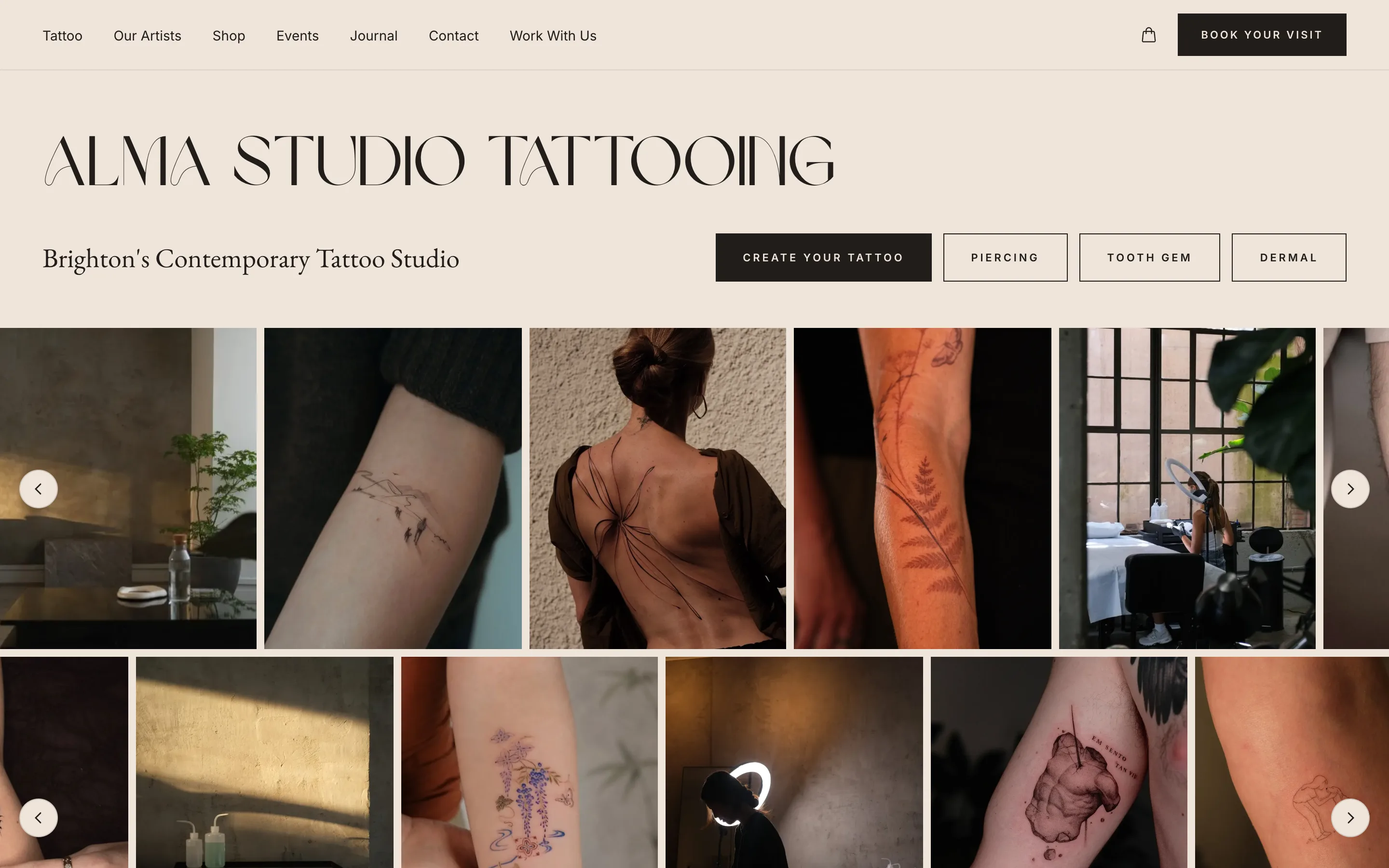
Organised portfolio. Instead of a chronological feed, the site presents work by category. Customers browsing for fine-line work see fine-line work. Customers looking for large-scale pieces see large-scale pieces. The portfolio becomes a tool, not a timeline.
Booking without DMs. A booking overlay connects directly to their scheduling system. Clients choose the service — tattoo, piercing, tooth gems, aesthetics — pick a time, and book. No waiting for a reply. No messages getting lost. No back-and-forth.
Guest artist showcase. Most studios host guest artists regularly. On Instagram, guest artist posts get mixed in with everything else. On the website, guest artists get their own section with their work, dates, and direct booking.
Trust and professionalism. A custom website signals permanence. It says "this is a real business with a real location and a real commitment to what we do." For something as personal and permanent as a tattoo, trust matters enormously.
The Booking Argument
No-shows are expensive for tattoo studios. A missed two-hour session at £150/hour is £300 in lost revenue. Multiply that by a few per week and it's thousands per year.
Online booking with deposits solves this. When a client books through the website and pays a £50 deposit upfront:
- They're financially committed — no-show rates drop dramatically
- You have their real contact details (not just an Instagram handle)
- The booking syncs to your calendar automatically
- You can send automated reminders
Compare this to DM booking: no deposit, no confirmation system, no reminders. Just a message thread and hope.
Portfolio Display: Instagram vs. Website
Let's be honest about what a tattoo portfolio should look like:
Instagram gives you: A grid of squares. Identical size, identical format. No context, no grouping, no narrative. Your healed fine-line butterfly is the same size as your full back piece. The medium doesn't serve the work.
A website gives you: Full-screen, high-resolution images organised by style. Before-and-after views for cover-ups. Close-up details for fine-line work. Descriptions of the process for complex pieces. The portfolio serves the work because you designed it to.
For artists whose work is their marketing, this matters. A potential client deciding between studios will choose the one whose work they can properly see and evaluate. A beautiful website portfolio does more selling than a thousand Instagram posts.
SEO for Tattoo Studios
Here's the search volume data that should convince you:
- "Tattoo studio Brighton" — hundreds of monthly searches
- "Tattoo artist near me" — thousands nationally
- "Fine line tattoo Brighton" — specific, high-intent searches
- "Tattoo booking Brighton" — people ready to spend
If you don't have a website, you don't appear for any of these. Your Instagram profile might show up on page two or three. But the studios with websites — with proper titles, meta descriptions, structured data, and location markup — are taking those clicks.
And these aren't casual browsers. Someone searching "tattoo booking Brighton" has their wallet out. They've already decided to get a tattoo. They're choosing where. If your website is the one that answers that search, that's a booked session.
What a Tattoo Studio Website Needs
Based on building these and talking to studio owners across Brighton and Sussex, here's the minimum:
- Hero section with your best work and studio vibe. Dark, atmospheric photography works beautifully for tattoo studios.
- Portfolio gallery organised by style or artist. Full-screen, high-res. Let the work speak.
- Artist profiles. Each artist's bio, specialties, and individual portfolio. Clients book artists, not studios.
- Services and pricing. Clear, honest pricing information. Hourly rates, minimum charges, deposit requirements.
- Booking system. Online booking with deposits. This alone will transform your operations.
- Location and contact. Google Maps embed, address, opening hours, phone number. Make it easy to find you and walk in.
- Reviews and testimonials. Pull your best Google reviews onto the site.
"But I'm Not a Studio, I'm a Solo Artist"
Even more reason to have a website. As a solo artist, your personal brand is everything. A website is your digital studio — it shows potential clients who you are, what you specialise in, and how to book.
A one-page website with your portfolio, a booking link, and your location costs a fraction of what a full studio site costs. And it positions you as a professional, not just someone with an Instagram account.
The solo artists in Brighton who have websites consistently get higher-quality enquiries — clients who've already seen and chosen their work, who show up prepared, who value the artistry. The DM enquiries are more often price-shoppers and no-shows.
The Investment
A tattoo studio website costs £2,000-£5,000 depending on complexity. A solo artist site costs less. Compare that to:
- One no-show per week at £200 = £10,400/year in lost revenue
- One new client per week from Google at £300 = £15,600/year in additional revenue
The website pays for itself within months. After that, it's a profit engine that works while you're tattooing.
If you run a studio in Brighton or Sussex and want to talk about what a website could do for your bookings, book a call.
Instagram shows your work. A website sells it.