Why Your Construction Company Needs a Website (Not Just Checkatrade)
Construction companies that rely only on Checkatrade leave money on the table. Here's why builders, tradesmen, and contractors need their own website.
Checkatrade is great. I'm not going to pretend it isn't. If you're a builder in Sussex with a 9.5+ rating and 200 reviews, you're getting work from it. The phone rings. Jobs come in. Life is good.
So why would you bother with a website?
Because Checkatrade is rented land. And rented land has rules you don't control.
The Checkatrade Problem
Checkatrade charges you a monthly fee. That fee gets you a profile on their platform. But here's what it doesn't get you:
You don't own the page. Checkatrade owns it. They can change the layout, the algorithm, the review display — anything — and you have zero say. One update could push your profile down the results.
You're listed next to competitors. Every visitor to your Checkatrade profile sees "Similar tradespeople nearby." You've paid to be on the platform, and the platform is actively showing your potential customers alternatives. Imagine hiring a salesperson who handed out your competitor's card after every pitch.
You can't tell your full story. A Checkatrade profile gives you a paragraph and some reviews. You can't show your best project photography in a gallery. You can't explain your process. You can't walk someone through what it's like to work with you.
You can't rank independently. When someone searches "builder Brighton" on Google, Checkatrade shows up — not you. Your individual Checkatrade profile rarely ranks for anything. You're helping Checkatrade's SEO, not yours.
What a Website Does Differently
I've built websites for construction companies across Sussex, and the pattern is always the same: they get them for credibility, but they keep them for leads.
Take Altoria Construction. Premium builder in Brighton, 20+ years of experience, luxury renovations and loft conversions. They had no website. All work came through referrals and Checkatrade. When we built their site, they got first-page Google rankings within weeks.

The reason is simple: Google wants to show searchers relevant, authoritative local businesses. A well-built website with real project photos, service descriptions, and structured data tells Google exactly what you do and where you do it. A Checkatrade profile is one of thousands — your website is uniquely yours.
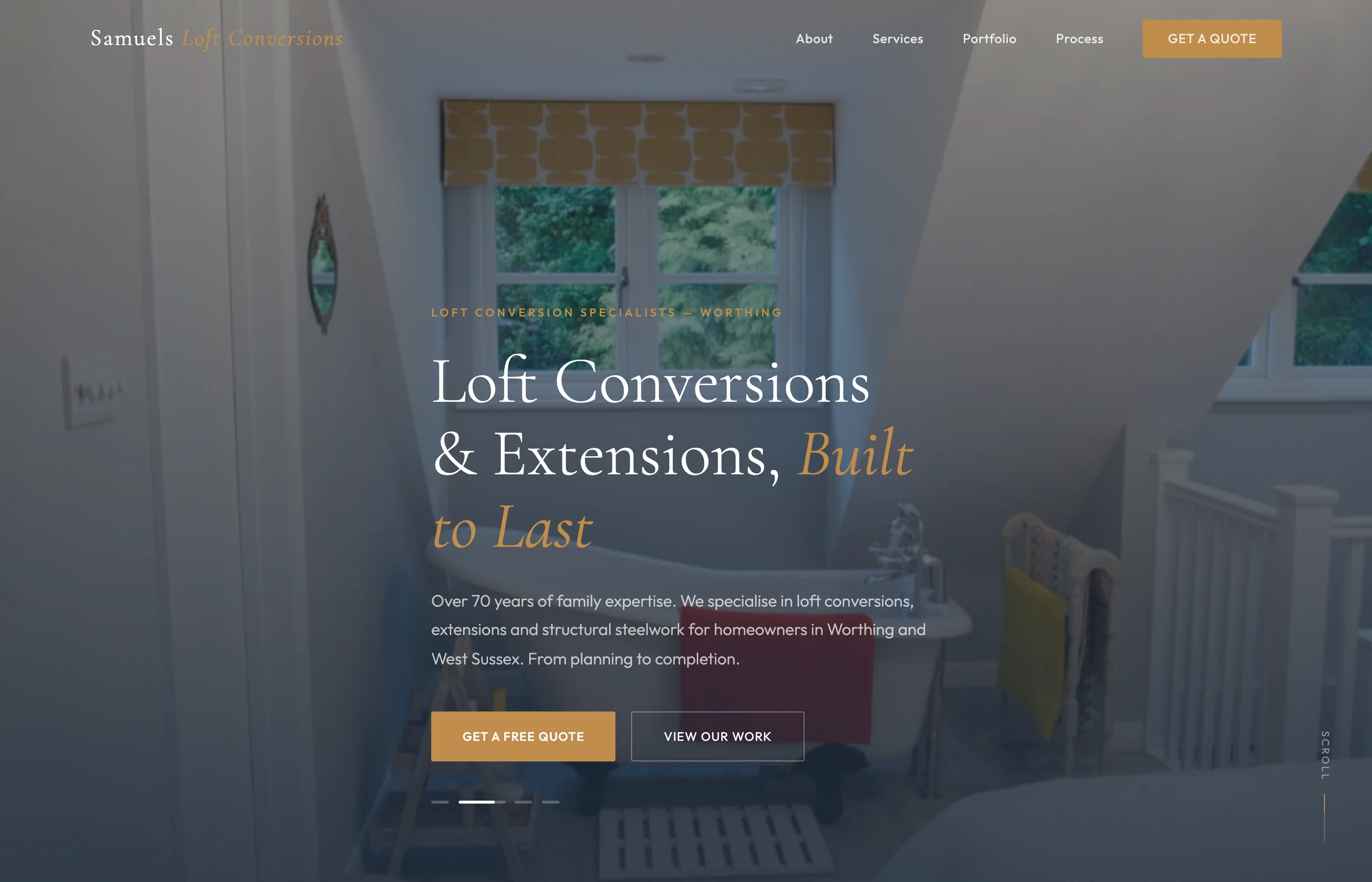
Samuels Loft Conversions was similar. Family business in Worthing, 70+ years of combined experience, incredible work — but no online presence beyond directories. Their website now ranks for loft conversion searches across West Sussex.
The Trust Multiplier
Here's something people don't talk about enough: a website makes your Checkatrade profile more effective, not less.
When a homeowner finds you on Checkatrade, what do they do? They Google your company name. If the first result is a professional website with project galleries, detailed service pages, and real photos of your team — that homeowner is now significantly more likely to call you.
If there's nothing? Just the Checkatrade profile and maybe a dead Facebook page? Doubt creeps in. "Are they legitimate? Are they established? Are they going to disappear after taking my deposit?"
For construction — where the average project is £20,000-£100,000+ — trust isn't a nice-to-have. It's everything. Nobody hands over that kind of money without doing research. Your website is where that research should lead.
The Portfolio Problem
Construction is visual. Before and after photos are the most powerful sales tool you have. A damp Victorian terrace transformed into an open-plan family home. A cramped attic turned into a master suite with skylights. An overgrown garden rebuilt into a tiered entertaining space.
These transformations sell. But on Checkatrade, you get a handful of small images buried below the reviews. On Instagram, they disappear into a chronological grid. Neither platform lets you present your work properly.
A website gives you full-screen, high-resolution galleries. You can organise projects by type — extensions, loft conversions, renovations, new builds. You can include the scope, timeline, and budget for each one. You can tell the story of the project, not just show the photos.
Coastal Tiling went from no online presence to a full portfolio site with a CMS, so Harvey can add new projects himself whenever he finishes a job. His gallery is now his best salesperson.

What a Construction Website Needs
I've built enough of these to know the formula. A good construction company website needs:
1. Hero with your best project. Full-width, high-quality photo. Not a stock image — your actual work.
2. Service pages. One page per service: extensions, loft conversions, renovations, new builds, whatever you specialise in. Each page should have photos, a description, and a way to enquire. This is critical for SEO — each page can rank for its own set of keywords.
3. Portfolio/Gallery. Organised by project type. Before and after photos where possible. Brief descriptions of scope and duration.
4. Testimonials. Pull your best Checkatrade reviews onto your site. You own those words — display them where they'll have the most impact.
5. Contact/Quote form. Make it easy. Name, phone, email, brief description of the job. Don't ask for twenty fields — you'll call them to discuss details.
6. Local SEO markup. Schema.org structured data that tells Google your business name, address, service area, and what you do. This is the behind-the-scenes code that makes you appear in map results and "near me" searches.
The Numbers
A builder's website costs between £1,500 and £4,000 to build properly. No monthly fees, no per-lead charges, no commissions.
One loft conversion job in Brighton is worth £40,000-£80,000. One extension is £30,000-£60,000. Even a bathroom renovation is £5,000-£15,000.
You need one job from the website to pay for it several times over. Everything after that is profit.
Compare that to Checkatrade: £80-£120/month for the listing, plus the implicit cost of being listed alongside competitors. Over three years, that's £3,000-£4,000 — roughly the same as a website — but you own nothing. Cancel the subscription and you're invisible again.
Keep Checkatrade. Add a Website.
I'm not saying ditch Checkatrade. It works. Keep it. But treat it as one channel, not your only channel.
Your website is the hub. Checkatrade, Google, Instagram, word of mouth — they all feed traffic to your website. Your website converts that traffic into enquiries. You own the experience from start to finish.
Every serious construction company in Brighton and Sussex will have a website within the next few years. The ones who get there first will own the Google results. The ones who wait will be fighting for whatever's left.
If you want to talk about building a website for your construction business, book a call.
Build houses for a living? Build your online presence too.