Why Every Landscaper and Garden Designer Needs a Portfolio Website
Landscapers and garden designers win work with visual proof. Here's why a portfolio website generates leads and how to build one that works.
Landscaping is one of the most visual trades that exists. The transformation from overgrown mess to beautiful outdoor space is dramatic, emotional, and — critically — photogenic.
And yet, most landscapers in Sussex don't have a website. They rely on word of mouth, a Facebook page, maybe a Checkatrade listing. Their best marketing material — the actual gardens they've built — sits in phone camera rolls, unseen by anyone who hasn't already hired them.
This is a wasted opportunity. Not a small one. A massive one.
Why Visual Work Needs a Visual Platform
Landscaping and garden design have an inherent advantage that most businesses don't: the before-and-after format.
A patchy, muddy lawn transformed into a multi-level terrace with composite decking. A tangled overgrown border redesigned into a structured planting scheme. A bare concrete yard turned into an outdoor kitchen with pergola and raised planters.
These transformations are compelling. People stop scrolling for them. They imagine their own garden looking like that. They picture themselves sitting on that deck, hosting dinner on that patio.
But only if they can see them.
A Facebook post gets engagement for 24 hours, then disappears into the feed. An Instagram post gets buried under hundreds of others within a week. A portfolio on your own website? That's permanent. It's there when someone searches "garden designer Brighton" at midnight. It's there when a referral checks you out before calling. It's there, working for you, indefinitely.
The Case Study: Brunswick Landscapes
I built the website for Brunswick Landscapes — Ed's garden design and landscape build business covering Brighton, Hove, and East Sussex.
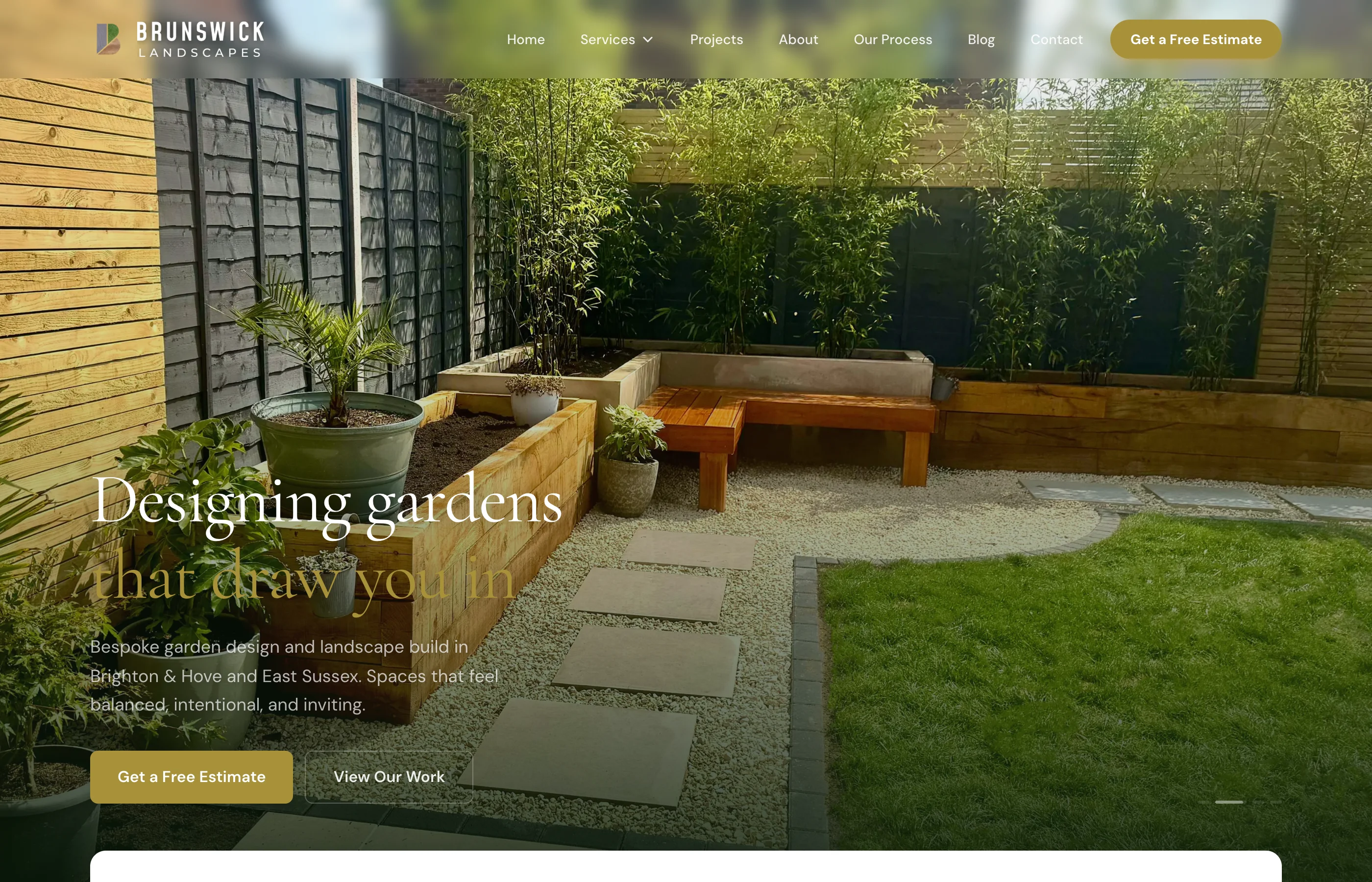
Before the website, Ed had a basic template site that didn't do justice to his work. He had stunning project photography but nowhere to properly display it. Leads came through word of mouth almost exclusively.
The new site changed that:
Full project galleries. Each completed garden gets its own gallery with multiple high-resolution photos. Not thumbnail grids — full-screen images that let visitors appreciate the quality of the work.
CMS for self-management. Ed can add new projects himself whenever he finishes a job. Upload photos, add a description, publish. No developer needed.
Service pages. Separate pages for garden design, hard landscaping, soft planting, maintenance — each targeting its own set of Google searches.
Multi-step quote form. Captures the essential details — garden size, location, budget range, what they're looking for — without being overwhelming.
Blog. Seasonal content that builds SEO authority over time: "Best time to redesign your garden in Brighton," "Low-maintenance garden ideas for Sussex coastal homes."
The result: Ed started getting inbound enquiries from Google — people he'd never met, who found him because his site ranked for what they were searching for.
What Landscaping Customers Search For
Understanding search intent is key. Here's what people actually type into Google:
- "Garden designer Brighton"
- "Landscaper near me"
- "Patio installation Sussex"
- "Garden renovation cost UK"
- "Low maintenance garden design"
- "Decking companies Brighton"
- "Garden designer Hove"
Each of these represents a potential customer actively looking for what you offer. If you don't have a website, you don't appear for any of them. Full stop.
Your Facebook page might show up on page three. Your Checkatrade listing will show up — next to five competitors. But a properly optimised website can rank on page one, with your full portfolio and your booking form right there.
Before and After: Your Best Sales Tool
I want to stress this because it's genuinely important: before-and-after photos are the most powerful content any landscaper can publish.
Nothing builds trust like showing the raw starting point and the finished result. It demonstrates:
- Skill — you can clearly see the transformation
- Range — different projects show different capabilities
- Scale — small gardens, large gardens, everything in between
- Style — modern, traditional, cottage, architectural
And the beauty of landscaping is that you can photograph every single project. It takes five minutes to snap before-and-after photos with your phone. Over a year, you build a portfolio of 20, 30, 50 projects — each one a piece of evidence that you're worth hiring.
On Instagram, these photos get likes. On your website, they get leads.
The Lead Generation Machine
Here's how a portfolio website turns photos into money:
- Someone searches "garden designer Brighton" on Google
- Your site appears on page one because it's optimised for that exact query
- They click through and land on your homepage
- They see your best work in the hero section — immediate impact
- They browse the portfolio and find a project similar to what they want
- They read the service page relevant to their needs
- They fill in the quote form with their garden details
- You receive the enquiry with all the information you need to quote
This entire journey — from search to enquiry — happens without you doing anything. It happens while you're on-site laying pavers. It happens at 11pm on a Sunday night. It happens because your website is doing the selling for you.
Compare this to word of mouth: effective, but limited to who your existing clients happen to know. Compare this to Facebook: useful for awareness, useless for capturing intent. Compare this to Checkatrade: decent for leads, but you're competing directly alongside alternatives.
Your website is the only channel where you control the entire experience from first impression to enquiry.
What a Landscaping Website Needs
Based on building these and understanding the market:
1. Hero with your best transformation. Full-width, jaw-dropping. The first thing they see should be your finest work.
2. Portfolio gallery. Organised by project type (patios, planting, full redesigns) or by area (Brighton, Hove, Lewes). Each project with multiple photos and a brief description.
3. Service pages. Dedicated pages for each service: garden design, hard landscaping, planting, maintenance, etc. Each page targets its own keywords and can rank independently.
4. Process section. "How we work" — initial consultation, design phase, build phase, handover. Customers want to understand what they're signing up for.
5. Quote form. Simple, friendly, not intimidating. Name, contact details, brief description, maybe a photo upload option.
6. Testimonials. Real quotes from real clients. With names and locations if possible.
7. Location and service area. Make it clear where you work. "Covering Brighton, Hove, Lewes, and East Sussex."
The SEO Advantage
Here's the thing about landscaping SEO: the competition is low. Most landscapers in Sussex don't have websites, and the ones that do often have poorly optimised ones.
This means a well-built website can rank on the first page of Google within weeks, not months. The barrier to entry is low because so few competitors have invested in their online presence.
But this won't last forever. As more landscapers realise the value of web presence, the competition will increase. The businesses that establish their sites now will have months or years of SEO authority built up — making them extremely difficult to displace.
First-mover advantage is real. In Brighton's landscaping market, it's still available.
If you're a landscaper or garden designer in Sussex and you're ready to turn your project photos into a lead generation machine, book a call.
Your gardens are beautiful. Your marketing should be too.